
STP / ETP Equipment · Rotary Rake Bar Screen
Rotary Rake Bar Screen Machine
Rotary Rake Bar Screen Machine
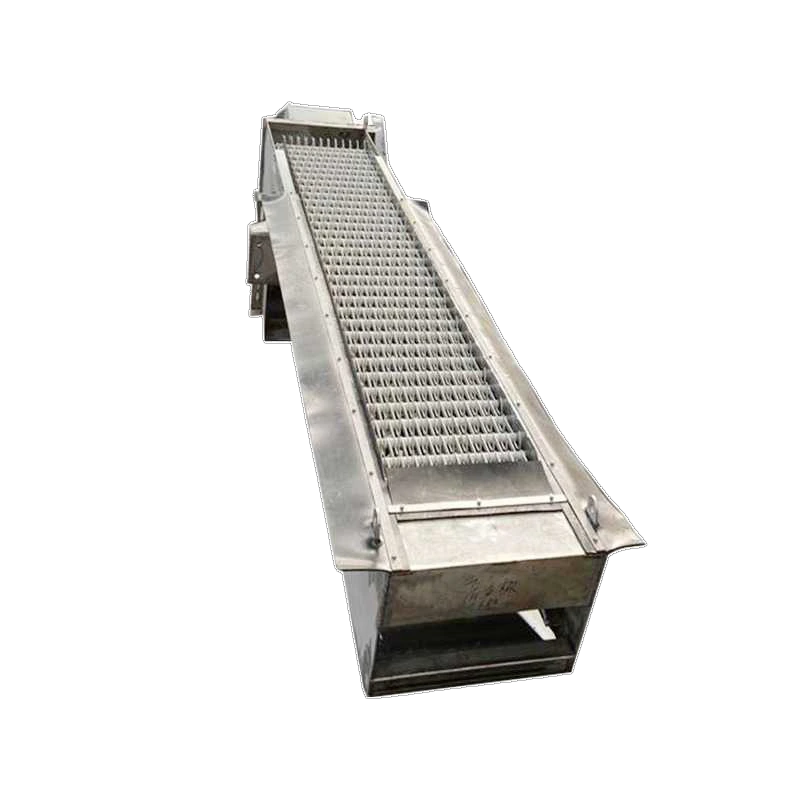
Used in the intake channels of urban sewage treatment plants, waterworks, and stormwater drainage systems to automatically intercept and remove floating debris from the water, ensuring the normal operation of subsequent processes.
- Channel width
- 800 – 3000 mm
- Channel depth
- 1000 – 15,000 mm
- Grid gap
- 10 – 100 mm
- Power
- 0.75 – 3 kW
What it’s for
Continuous Screening, Automatic Discharge
A motor-driven chain and sprocket system powers the scraper rakes, which travel through the screen bars to capture coarse debris. Collected screenings are lifted above the water level and automatically discharged into a conveyor or collection bin, ensuring continuous, reliable screening.
Anti-jamming design, overload protection and high-efficiency debris removal keep the unit running in a compact, low-maintenance footprint, with simple electrical controls that are automation-ready out of the box.
Construction
How It’s Built
Specifications
Technical Data
- Channel width
- 800 – 3000 mm
- Channel depth
- 1000 – 15,000 mm (customized)
- Height over channel
- Discharge height + 1350 mm
- Discharge height
- 400 – 1500 mm (standard 800 mm)
- Screen angle
- 60°, 65°, 70°, 75° or 80° (75° recommended)
- Grid gap
- 10, 15, 20, 30, 40, 50, 60, 80 or 100 mm
- Grid thickness
- 8 mm
- Power
- 0.75 – 3 kW, by channel width
- Fixing at floor level
- 2 embedded steel plates, 500 × 200 × 12 mm, or 4 M16 × 150 expansion bolts
- Floor slab
- Reserved opening over the channel
- Length along the channel
- 1500 mm + channel depth × cot(screen angle)
Channel dimensions
Operating range
Installation
- P 800
- 700 mm in channel · 1,080 mm overall · 0.75 – 1.1 kW
- P 1000
- 900 mm in channel · 1,280 mm overall · 0.75 – 1.1 kW
- P 1200
- 1,100 mm in channel · 1,480 mm overall · 0.75 – 1.1 kW
- P 1400
- 1,300 mm in channel · 1,680 mm overall · 1.1 – 2.2 kW
- P 1600
- 1,500 mm in channel · 1,880 mm overall · 1.1 – 2.2 kW
- P 1800
- 1,700 mm in channel · 2,080 mm overall · 1.1 – 2.2 kW
- P 2000
- 1,900 mm in channel · 2,280 mm overall · 1.1 – 2.2 kW
- P 2200
- 2,100 mm in channel · 2,480 mm overall · 1.1 – 2.2 kW
- P 2400
- 2,300 mm in channel · 2,680 mm overall · 1.1 – 2.2 kW
- P 2600
- 2,500 mm in channel · 2,880 mm overall · 1.1 – 2.2 kW
- P 2800
- 2,700 mm in channel · 3,080 mm overall · 2.2 – 3 kW
- P 3000
- 2,900 mm in channel · 3,280 mm overall · 2.2 – 3 kW
Model sizes
Applications
Where It’s Specified
Protects intake channels at sewage treatment plants and effluent treatment plants, catching floating debris before it reaches downstream equipment.
Screens process wastewater ahead of treatment across food & beverage, paper & pulp, textile & dyeing, and chemical & pharmaceutical operations.
Handles high-debris wastewater from meat processing and slaughterhouse operations, and general commercial wastewater treatment systems.
Common questions
Frequently Asked Questions
How do you size a bar screen for our site?
Sizing is based on your channel width, tank depth, and flow/treatment capacity — our engineering team assesses your site before recommending a model.
What does the model code mean?
It reads channel width, grid gap, grid thickness and screen angle in sequence — for example, P2000-30x8-75 is a 2000 mm channel with a 30 mm grid gap, 8 mm grid thickness and a 75° angle.