
STP / ETP Equipment · Radial Aerator
Radial Aerator
Self-Aspirating Submersible Aerator
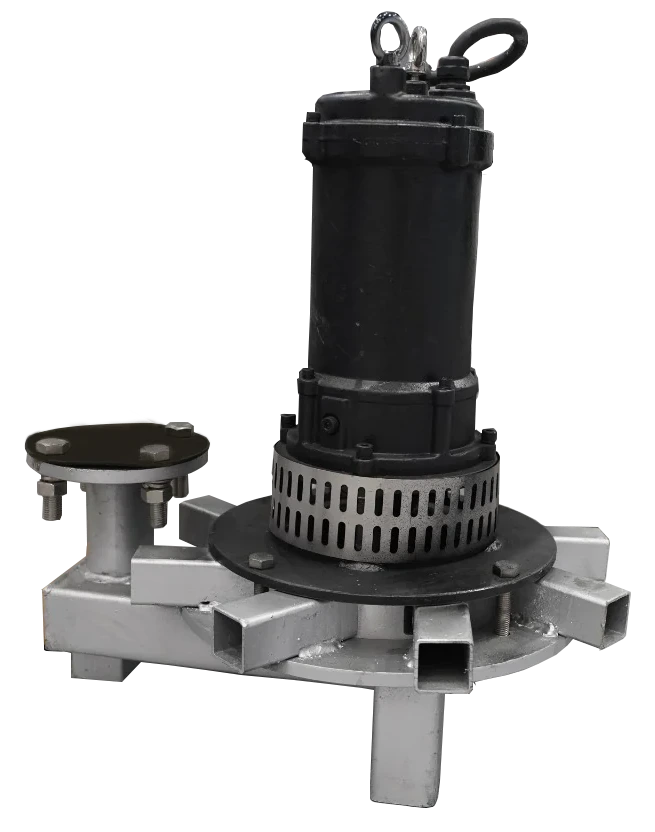
A self-aspirating submersible aerator that mixes and aerates in one — no compressed air supply, no bridges or special structures, and simple to install even in a flooded tank. Quiet, free of aerosols, and able to supply emergency oxygen during overloads or breakdowns.
- Motor power
- 1 – 10 HP (0.75 – 7.5 kW)
- Inlet depth
- 2 – 6 m
- Air intake
- 10 – 100 m³/h
- Oxygenation
- 2.9 – 10.6 kgO₂/h
What it’s for
Mixing and Aeration Without Compressed Air
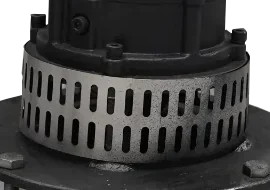
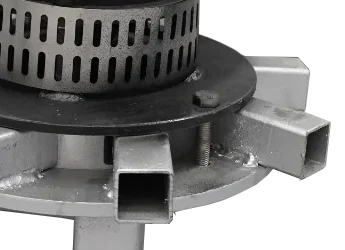
A radial aerator draws its own air. The submersible motor pulls atmospheric air in through the air inlet and drives the air-water mix outward through its radial arms, so the tank is aerated and mixed at the same time — with no blower, compressor or air pipework to install. Standing on the floor of the tank, the arms spread the mix across it, so few dead zones are left.
Because it works submerged, it runs quietly compared with surface systems and throws up no aerosol spray, and it keeps working where water levels vary, with no bridges or special support structures needed — a compact, cost-effective unit. It is ideal for wastewater containing sewage, organic industrial effluent and slurry, and can supply oxygen during breakdowns or overloads elsewhere in the plant.
Construction
How It’s Built
Specifications
Technical Data
- PAR-2-1.0
- 0.75 kW / 1.0 HP · 2.4 A · 2 m inlet depth · 10 m³/h air intake · 0.37 m lifting height · 2.9 kgO₂/h
- PAR-2.5-2.0
- 1.5 kW / 2.0 HP · 4 A · 2.5 m inlet depth · 22 m³/h air intake · 1 m lifting height · 4 kgO₂/h
- PAR-3-3.0
- 2.2 kW / 3.0 HP · 5.8 A · 3 m inlet depth · 35 m³/h air intake · 1.8 m lifting height · 5.3 kgO₂/h
- PAR-3.5-4.0
- 3 kW / 4.0 HP · 7.8 A · 3.5 m inlet depth · 50 m³/h air intake · 2.75 m lifting height · 6.3 kgO₂/h
- PAR-4-5.0
- 4 kW / 5.0 HP · 9.8 A · 4 m inlet depth · 75 m³/h air intake · 3.8 m lifting height · 7.2 kgO₂/h
- PAR-6-7.5
- 5.5 kW / 7.5 HP · 12.4 A · 6 m inlet depth · 85 m³/h air intake · 5.3 m lifting height · 8.6 kgO₂/h
- PAR-6-10.0
- 7.5 kW / 10.0 HP · 17 A · 6 m inlet depth · 100 m³/h air intake · 8.2 m lifting height · 10.6 kgO₂/h
- Voltage / phase
- 380 – 415 V / 3 ph
- Speed
- 1440 – 1470 rpm
- Protection
- IP 68
- Insulation
- Class F
- Duty
- S1 (continuous)
- Medium temperature
- 40 °C maximum
- Cable length
- 10 m
Performance chart — seven models
Electrical & duty
- Impeller
- SS 304
- Shaft
- SS 420
- Mechanical seal
- Silicon carbide
- Aeration arms
- Galvanized steel
- Worked example
- PAR-2-1.0
- PAR
- Radial aerator
- 2
- Submergence depth, in m
- 1.0
- Motor power, in HP
Materials
How to read the model code
Applications
Where It’s Specified
Mixes effluent in equalization and balance tanks while the added oxygen helps prevent septicity.
Sequential batch reactor treatment plants and aerobic digesters, aerating and mixing from one unit.
Keeps homogenization tanks uniform, and is ideal for the cleaning of storm tanks.
Adding oxygen to ponds, aquaculture ponds and landscape water, where water levels vary — with no bridges or special support structures to build.
Feed-water pre-treatment in sewage and effluent treatment plants: aerated grit chambers, pre-aeration tanks, air flotation tanks and stirring.
Biological oxidation plants, sludge stabilisation and post-aeration, where the tank has to be aerated and kept mixed at once.
Common questions
Frequently Asked Questions
Does it need a blower or compressed air?
No. The radial aerator is self-aspirating: it draws atmospheric air in through its own inlet, so there is no compressed air supply to install or run.
How does it mix the air into the water?
The impeller’s offset creates an air cavity, and air from the inlet is drawn from it into the water flow as an emulsion. The air-and-water mix is then forced out along the expulsion channels of the radial arms, which are shaped to keep the air in contact with the water for longer and to spread it over as much of the tank as possible.
Can it go into a tank that’s already full?
Yes — it is simple to install even in a flooded tank, and it needs no bridges or special support structures.
Jet, radial or push flow aerator — which one?
Jet aerators use the venturi-nozzle principle and suit small-to-medium sewage plants up to 6 m deep. Radial aerators are self-aspirating and easy to install even in a flooded tank. Push flow aerators combine fine-bubble aeration with mixing and circulation, and are mostly used for ponds, lakes and landscape water rather than industrial tanks.